
Test your API Credentials
Search for CSM Sales Channel and select the related link
- Load the Sales Channel you'd like to test
- Under the APIs ribbon option, select Test Communication
- You should see a positive/valid response in a popup message (ideally, a 200 response is what you're looking for)
Note: If the test failed, please verify your API credentials (instructions below), search the knowledge base or contact support.
API Response Codes
Each platform can respond with its own interpreted response codes that indicate how the connection was handled. Below are the most common API response codes and what each one means:
| Code | Name | Meaning |
|---|---|---|
| 1xx — Informational | ||
| 100 | Continue | Server received headers, client should send body |
| 101 | Switching Protocols | Server is switching to the requested protocol |
| 2xx — Success | ||
| 200 | OK | Request succeeded; response body contains the result |
| 201 | Created | Resource successfully created (common on POST) |
| 202 | Accepted | Request accepted for processing but not yet completed |
| 204 | No Content | Success, but no response body (common on DELETE) |
| 206 | Partial Content | Returning a portion of the resource (range request) |
| 3xx — Redirection | ||
| 301 | Moved Permanently | Resource has a new permanent URL; update your bookmarks |
| 302 | Found | Temporary redirect; continue using original URL |
| 304 | Not Modified | Cached version is still valid; no body returned |
| 307 | Temporary Redirect | Like 302 but preserves HTTP method (POST stays POST) |
| 308 | Permanent Redirect | Like 301 but preserves HTTP method |
| 4xx — Client error | ||
| 400 | Bad Request | Malformed syntax, invalid parameters, or missing required fields |
| 401 | Unauthorized | Authentication required or credentials are invalid |
| 403 | Forbidden | Authenticated but lacking permission for this resource |
| 404 | Not Found | Resource doesn't exist at this URL |
| 405 | Method Not Allowed | HTTP method not supported on this endpoint (e.g. POST on a GET-only route) |
| 408 | Request Timeout | Server timed out waiting for the request |
| 409 | Conflict | Request conflicts with current resource state (e.g. duplicate entry) |
| 415 | Unsupported Media Type | Content-Type not supported (e.g. sending XML when JSON is required) |
| 422 | Unprocessable Entity | Valid syntax but semantically invalid (e.g. validation errors) |
| 429 | Too Many Requests | Rate limit exceeded; back off and retry after the specified interval |
| 5xx — Server error | ||
| 500 | Internal Server Error | Generic server-side failure; something broke |
| 501 | Not Implemented | Server doesn't support the requested functionality |
| 502 | Bad Gateway | Upstream server returned an invalid response |
| 503 | Service Unavailable | Server temporarily down (maintenance, overloaded) |
| 504 | Gateway Timeout | Upstream server didn't respond in time |
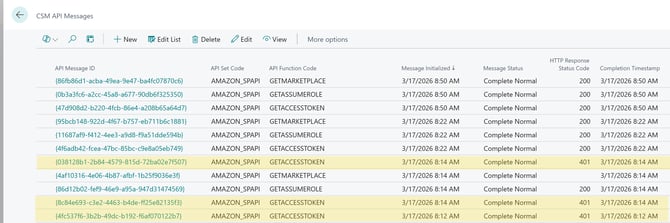
To review historical/logged API response codes, search for CSM API Messages (or API Messages if your platform is on our newer API Engine) and select the related link - here is an example of API responses that returned errors
Verify your API Credentials
Search for CSM Sales Channel and select the related link
- Load the Sales Channel you'd like to check credentials for
- Select Actions > API & Automation > API Credentials
- Select the impacted API Set Code
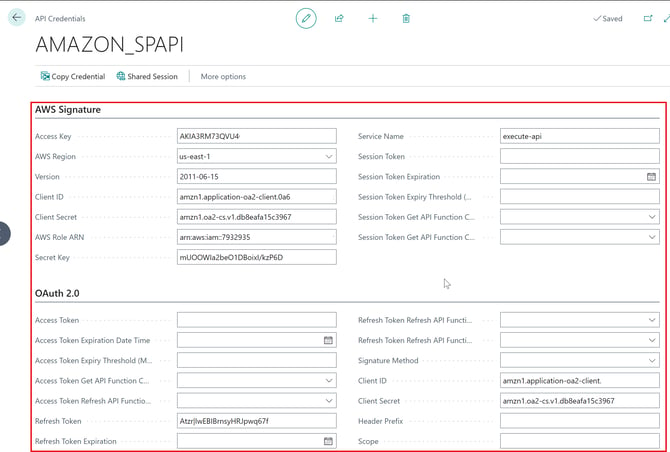
- Check for Typos: Ensure that there are no typographical errors in your API keys.
- Confirm Format: Make sure that all credentials are in the correct format as required by your Marketplace/eCommerce platform (e.g., no extra spaces or invalid characters); be careful when you copy and paste text to not include leading or trailing spaces.
- Select the impacted API Set Code
- Select Actions > API & Automation > API Credentials