
In this article:
Three Standard Sales Options | Billing a Lot Selection Package | Package Type | Payment Type | Before Invoice Creation | Creating the Invoice - Step by Step | After Invoice Posting | Sales Document Creation - Two Methods
Sales Consist of Three Standard Options:
- Closing Adjustment Journal (an automated general ledger transaction for the sale of the Lot).
- Lot Selection Packages, also known as a Color Chart, which can be billed either as an invoice to the purchasers or as part of the closing adjustment journal. Which of the two applies is set by the Payment Type field on the package. See Billing a Lot Selection Package below.
- After-Sales and Warranty - normally not sales, but can include billable amounts if necessary.
Billing a Lot Selection Package
A Lot Selection Package records what the purchaser chose at the selection appointment, the Upgrades, the Extras and any Customer Fees, and once it is released, it has a value. Two fields on the package decide what that value does next: Type, which says what kind of package it is, and Payment Type, which says how the purchaser pays for it.
Type: Color Chart or Addendum
Every package is one or the other.
| Type | What it is |
| Color Chart | The main selection package for the Lot, the purchaser's original set of choices. Only one Color Chart package can exist for a Lot. If you try to create a second, the system stops with "Only one Lot Selection Package can have Type 'Color Chart' for a Job." A cancelled package does not count against the limit, so a Color Chart that was cancelled can be replaced. |
| Addendum | Any later addition to, or change from, the Color Chart. There is no limit on the number of Addendum packages for a Lot, and each one carries its own Payment Type, its own status and its own amounts. |
New packages default to Color Chart if the Lot has none yet, and to Addendum once it has.
Payment Type: Amendment or Invoice
Payment Type answers as single question. Does the purchaser pay for this package now, or at closing?
| Payment Type | What happens |
| Amendment |
The value of the package is added to the price of the home. The purchaser chooses $20,000 of upgrades and extras, the builder and the purchaser agree that the price of the house rises by $20,000, and that amount is carried into the purchaser's mortgage and settled at closing. Mechanically: once the package is Released, its Amount Incl. Tax rolls up into the Lot's Amendment field, which is added to the Offer Price to give the Lot's Total Price, and is settled through the Closing Adjustment Journal. No sales invoice is raised, and Create Sales Invoice stays unavailable. |
| Invoice |
The purchaser pays for the package now, separately from the closing, even though the home may not be finished for another year. A payment needs a document behind it, so the package raises its own sales invoice, independent of the closing. Mechanically: once the package is Released, Create Sales Invoice becomes available and produces an unposted Sales Invoice for the package's customer. The package's value is not added to the Lot's Amendment. |
Note
Set Payment Type while the package is still Open. The field is editable only at status Open. Once the package is Closed it is locked, and by the time it is Released (which is when either route takes effect) it cannot be changed at all. If the wrong Payment Type was chosen, re-open the package before closing it again.
Payment Type is set per package, not per Lot. A Lot can have its Color Chart on Amendment and a later Addendum on Invoice, or the other way round.
The rest of this section covers the Invoice route.
Before You Can Create the Invoice
Create Sales Invoice appears on the Lot Selection Packages and All Lot Selection Packages lists and on the Selection Package Card, under Actions. It is always visible, but it is greyed out until all four of the following are true:
- Payment Type is Invoice. An Amendment package is billed at closing and cannot be invoiced this way.
- The package is Released. This is the one that catches people out. The invoice is built from the package's Planning Lines, and Planning Lines are not created for a Lot Selection Package until it is released. Before release there is nothing to invoice.
- No invoice has been created from the package yet. Meaning, the package's Sales Invoice No. is still blank. See After Posting below for when that field is filled in.
- The licence is active.
When the action does run, it re-checks the same conditions and several more that cannot be shown on a ribbon. Each one stops the routine with a message:
- The package has a Customer No. It is normally copied from the Lot's Sell-to Customer No. when the package is created. If the field is empty the routine stops with "Customer No. is not defined in Lot Selection Package X."
- The customer is set up for tax. A Tax Area Code in North American localizations, or a VAT Bus. Posting Group elsewhere.
- Sales & Receivables Setup has its number series. Both Invoice Nos. and Posted Invoice Nos. must be filled in.
- Every priced Planning Line of the package is of Type Item. Lines of any other type stop the routine.
- Every priced Planning Line has a Revenue Detail Code. It is copied from the Construction Item when the choice is sited, by way of the Phase or Model Item. A line without one stops the routine, naming the line.
- None of those Planning Lines is already on another sales document. If a line is already on a Sales Invoice or a Sales Order, the routine stops and names the document.
Note
"priced Planning Lines" here means the package's Planning Lines with a Total Price greater than zero. Standard choices are priced at zero and are not invoiced, which is the point of the check that Validate Selected performs before release, that Standard choices must be priced at zero and Extras and Upgrades must not.
Creating the Invoice — Step by Step
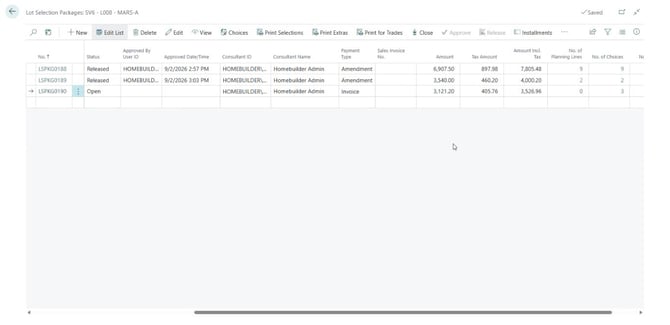
The example below follows a small Addendum package, LSPKG0190, on Lot L008 of Phase SV6, for customer CUS00012.
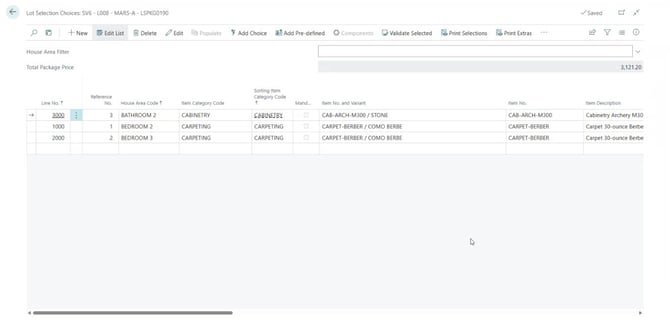
- Build the package and enter the choices. Create the package, set Type and set Payment Type to Invoice while the package is still Open, then add the purchaser's choices on the Choices page.
- Check the amounts on the package. The system maintains three fields on the package as the choices are entered: Amount (the sum of the choices' Total Price), Tax Amount, and Amount Incl. Tax. Nothing needs to be calculated by hand.
- Close, Approve and Release the package. Release runs the choice validation first, then asks for confirmation because releasing cannot simply be undone once downstream documents exist.
- Confirm that the Planning Lines were created. Release sites the choices, which creates one Job Planning Line per choice. The package's No. of Planning Lines goes from 0 to 3, and the lines can be inspected from the package through Related > Package Planning Lines. This is the linkage the invoice is built from.
- Run Create Sales Invoice. With the package Released and Payment Type Invoice, the action is now enabled under Actions.
- Enter the dates. The Create Sales Invoice from Lot Selection Package dialog opens, captioned with the Phase, the Lot and the package number so it is clear which package you are billing. Enter the Document Date and the Posting Date. Both are mandatory; leaving either blank stops with "Please specify all fields." Neither date has to be today — set the Posting Date to the period the payment belongs in.
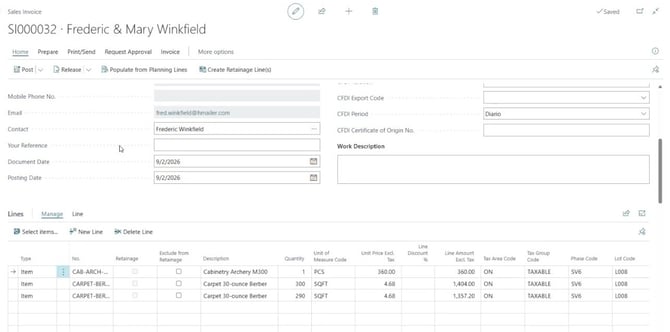
- Choose OK. The system runs the checks listed above, creates a Sales Invoice for the package's customer, and fills its lines from the package's priced Planning Lines. It confirms with "Sales Invoice X has been created."
What the Invoice Contains
- The customer. The package's Customer No. in the example below, CUS00012, Frederic & Mary Winkfield.
- The lines. Every Planning Line belonging to that Lot and that Selection Package with a Total Price greater than zero. In practice this is the purchaser's Upgrades, Extras and Customer Fees; Standard choices, priced at zero, are left off. In the example the three lines total 3,121.20, which is the package's Amount.
- The link back to the budget. Each sales line is created against its Planning Line through the Job Contract Entry No., which is what allows the system to tell later that a Planning Line has already been billed.
- The link back to the package. The invoice header is stamped with the Phase Code, the Lot's Job No., and the Lot Selection Package No.; the lines carry the Phase Code and Lot Code as well.
Note
The invoice is created, not posted. Create Sales Invoice produces an ordinary unposted Sales Invoice and stops there. From that point it behaves like any other sales invoice: review it, add or adjust lines if you need to, and post it in the usual way.
After Posting
Posting is what closes the loop:
- The package's Sales Invoice No. is filled in with the posted invoice number.
- Each Planning Line drawn onto the invoice has its own Sales Invoice No. stamped with it.
Caution
Until the invoice is posted, the package does not record it. The Sales Invoice No. on the package stays blank while the invoice is still a draft. Running it a second time will not silently create a duplicate: it stops on the check that the Planning Lines are already part of a Sales Invoice, and names that invoice. But if a draft invoice is abandoned rather than deleted, its Planning Lines stay locked to it and no second invoice can be raised from the package until the draft is deleted. Delete abandoned drafts.
Deposits Are a Separate Matter
Checks and deposits taken from the purchaser at the selection appointment are recorded as Package Installments on the package, and are transferred to the Lot as Lot Installments of category Extra when the package is released. They are recorded regardless of Payment Type and are not the same thing as invoicing the package. See the Lot Payments and Closing articles.
There are two methods of creating sales documents related to Lot costing.
- By populating sales lines from Planning Lines – pull the lines from Lot Planning Lines onto the Sales document.
- E.g.: From a Sales Invoice, select the proper customer assigned to the Lot you are selling and hit Populate from Planning Lines:
[image coming soon]
- By manually entering Phase, Lot and Cost Details on sales lines, using either a G/L Account No. or an Item.
Which route to use
The two methods above start from a Sales Invoice and pull Lot Planning Lines onto it, and they are the right choice for anything billed against the Lot budget generally.
A Lot Selection Package is different: it already knows exactly which Planning Lines belong to it, so it raises its own invoice through Create Sales Invoice on the package rather than being assembled by hand.
Use Populate from Planning Lines when you are billing the Lot; use Create Sales Invoice on the package when you are billing a selection package. See Billing a Lot Selection Package above.
Note
Posting sales documents related to lot costing has the following prerequisites.
- A Lot Budget Line must exist in the Lot Budget for the Cost Detail Code specified on the sales line. Refer to the section "Lot Budget".
- A Lot must have a "Customer No." assigned to it. If the lot has not been purchased yet, create and assign a temporary customer, for example, 'INVENTORY'.
- If you create a sales document by entering Phase, Lot and Cost Details, make sure the task associated with the Cost Detail record (see the Cost Details page) exists under the Lot. Refer to the section "Construction Workflow Templates", action "Push to Lots".